Arlington Industries Wire Grabber: The Tiny Connector That Holds Up to 100 Lbs.
Filed under: Cable Ties, Clips and Grommets, Raceway, Duct and Conduit
Every time I use a tiny picture hanger to mount 30 pounds of frame, matting and glass on the wall, I can’t seem to believe that a nail/bracket combo that’s barely the size of a quarter can possibly keep heavy wall art suspended for any length of time. Every time I’m in the framing section of the craft store to pick up more picture hanging supplies (which is surprisingly often), I find myself looking at the weight ratings on the packs of hangers, and thinking “Yeah, right.” But somehow, without fail, I always end up putting my trust in these miniscule pieces of metal, and you know what? I haven’t been let down yet.
Now that you know about my admiration for miniature metal fasteners that are greater than the sum of their parts, you probably won’t be surprised to hear that I’m newly enamored of (what else?) a little steel connector with a lot of holding power, also known as the Wire Grabber™ by Arlington Industries.
Although the Wire Grabber is designed to grasp hanging wires and support impressive amounts of weight, it has nothing to do with mounting wall art – it’s actually used to suspend cable trays and other fixtures from beams and purlins. As a matter of fact, the Wire Grabber’s name really says it all. Its main function is to create strong hanging loops in the steel wire that suspends cables trays from the ceiling. Here’s how it works.
The Wire Grabber is made up of 3 components: a base, a clip, and a screw. You start out by running the loose end of a suspending wire through the Wire Grabber’s base. After that, you insert the wire end through the hanging ring or hook on your cable tray or light fixture, and then thread it back through the Wire Grabber’s base in the opposite direction. Once that’s done, you just fit the top clip into the base and tighten the set screw. That’s it – the Wire Grabber will hold the newly-formed hanging loop in place, even under a weight load of up to 100 pounds.
What’s really nice about the Wire Grabber is that even though it makes contact with the hanging wire in 6 places, it never actually bites into the wire or causes damage, so if you need to adjust hanging height or switch out a fixture, you can use the exact same piece of wire over again. The Wire Grabber’s holding power is also unaffected by oils and grease, so you can use it even in less-than-pristine environments without any worry.
Panduit Cable Bundle Organizing Tool: Straight, Organized Cable Bundles Without the Stress and Hand Strain
Filed under: Cable Ties, Clips and Grommets, Cable Wraps
“Cable bundle.” It sounds so benign, doesn’t it? And in a way, cable bundles are a good thing – after all, wouldn’t you rather have all of your cords in one cohesive group than running wild in every direction? Cable bundling is definitely the way to go. The only thing is, when you start dealing with handfuls of cables, they can get a little tricky to manage. Between Point A and Point B, they can switch places and wind around each other, and there are always at least a couple of renegades that try to make a break from the rest of the pack. It’s like the proverbial herding of cats – have fun with that.
I used to use wire loom to corral all of the computer and phone cables under my desk, and in order to get cables into wire loom, you have to do a little makeshift bundling first. Long story short, even a measly desk’s worth of cables can be a challenge. What on Earth do cabling installers do for heavy duty backbone cable runs? My guess is that they have to really put their backs… and arms… and both hands… into it. I don’t know about you, but I try not to put myself through frustration and physical duress at the same time, and that’s why I really like the idea of Panduit’s Cable Bundle Organizing Tool.
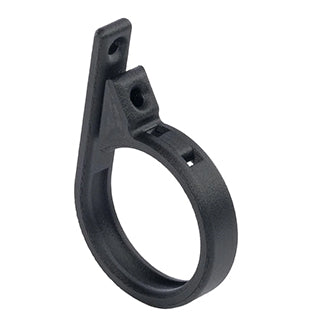
This cable organizer is so simple, yet so brilliant. Structured in a generally round shape, which is more or less the same form you’d want a cable bundle to take, the Panduit organizer actually creates order from the inside out. It’s full of individual spaces that you can slide cables into – each and every cable gets a designated space. Once all of your cables are inserted into the organizing tool, you snap an outer ring around the loaded frame, secure it with the included hook and loop wrap, and slide the configured organizer down the length of the bundle, installing additional cable ties along the way. It more or less combs the cables into the same positions the entire way, so you’re left with a cable bundle that’s smooth and well-ordered, without the stress and exhaustion of having to take care of every last detail yourself.
That’s working smart.
Two-Piece Desk Grommets: Endless Options for Cable Routing and Other Creative Workspace Modifications
Filed under: Cable Ties, Clips and Grommets, Desk Cable Organizers
Chances are, a few of you are asking yourselves, “She’s talking about grommets again? Really?” To all of you exasperated naysayers, I say, “Give me a chance.” I don’t blog just to hear the sound of my own voice, and I don’t like wasting peoples’ time with things they’ve already heard about. I’m enthusiastic about grommets – we’ve covered that. But the entire reason for this post is that my eyes were just opened to a new and exciting way to use desk grommets.
Well, not just any desk grommets… to be more specific, the new round two-piece grommets that we just started carrying. They’re simple, but extremely cool, because they come in (as you’ve gathered) two separate parts: the sleeve, which is the section that lines the actual hole cutout in your desk or countertop, and the snap-on top, which narrows the opening so that it fits snugly around the wire and cables traveling through it. Up to this point, most grommets have been a one-piece hybrid of the two parts, but someone had the outstanding idea to go deconstructionist on these, and I really think it works.
Why? Because you can use both components together, or take the more-laid back approach and just stick with the sleeve. The complete solution is perfect for routing cables (as usual), but what really intrigues me is the sleeve-only option, and the suggestion that, when you’re dealing with the large-diameter 4″ grommet, the sleeve can actually be fashioned into a sort of through-desk trash chute.
Ever noticed how in some restaurant bathrooms, there’s a cutout in the sink vanity, into which you toss your used paper towels? Well, now you can do the same thing to your desk! Just use a hole saw to cut out an opening, snap in a grommet sleeve for a finishing touch, line your wastepaper basket up below the hole, and start dropping your small paper trash right through your desktop. Bombs away!
Extra Long Hook-and-Loop Wraps: Big Jobs Need Big Cable Ties
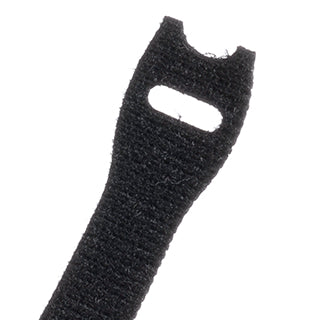
What is it about hook and loop cable ties that we’re all so crazy about? Standard-size hook and loop wraps have been one of our hottest sellers for years, so it’s no surprise that you’ll find one lurking on the laptop cord of almost anyone you know. Then we got the mini version, which, considering the fact that it’s scaled down for use with iPod earbuds and iPhone charger cords, is even cooler. No matter what the size or brand, they’re just great in general: you can reuse them hundreds of times, they don’t crush cables, and they’re known to come in more than a few cool colors.
But what happens when your love for the rippy stuff grows so much that you want to start using hook and loop wraps for even bigger jobs? Maybe you want to circumvent an entire cable tray, or keep a coiled-up garden hose bundled? Maybe you have a rolled-up drop cloth or camping tarp that you’d like to neatly store or transport in proper Yodel-like formation. Good luck getting that done with an average-sized hook and loop wrap. At very best, you could link a few ties together, but that would be for extreme situations requiring MacGyver-like improvisation.
If I were you, I’d just buy some extra-long hook and loop cable ties to begin with.
As their name so strongly implies, Economical Long Hook and Loop Ties are cost-effective, longer than usual (to the tune of 12″-24″), and made of the beloved Velcro-like hook and loop material. Given their size and capabilities, they can really be classified more as bundling straps than garden-variety cable ties – as a matter of fact, they can hold up to 18 lbs during use. Not too shabby. In addition to the cable, hose and tarp-related uses I mentioned above, these would also be perfect for managing sports equipment, keeping beach umbrellas furled (or making carrying handles for them), and lashing things together in general.
ACT Cobra Low Profile Cable Ties: No More Snagging
So there you are, bundling wires with zip ties like there’s no tomorrow. You’re carefree, you’re getting things done – as a matter of fact, it’s pretty much all fun and games until… somebody gets snagged by a cable tie. That “somebody” might be your sweater cuff, a cable, one of the rails inside your server enclosure, you name it. But one thing’s for sure: that snaggage is annoying, and if it hasn’t caused outright damage, it’s at the very least slowing you down. As my old friends Winnie the Pooh and Alton Brown like to say, “Oh bother.”
ACT Fastening Solutions has heard our collective cable management lament, and responded with the creation of Cobra® Low Profile Cable Ties. Like the snake they’re named after, these “zero-clearance” cable ties have a flat head, which results in a smooth profile that won’t “bite” into skin or cable insulation, or get snagged on fabric, conduit, or nearby fixtures. Once wrapped and secured around a cable bundle, low profile Cobra® cable ties lay flat around the entire circumference, with just the tiniest bit of thickening where the head is. No sudden elevation jump with sharp corners – just a smooth band all the way around. That low profile head also hides the sharp, cut edge after you’ve trimmed away the excess – once you snip the end, the cut edge just slides back into the head for a perfectly snag-free finish.
Another nice thing about ACT Cobra® ties is that they’re safe and easy to remove. Whereas you generally have to jam a pair of scissors between tie and cables to remove a standard zip tie, you just snip the top crossbar to release the Cobra® tie. This prevents you from accidentally slicing into nearby cables, which is never a good thing.
And lastly, I can’t forget to mention that Cobra® ties have excellent tensile strength, and are even tamper-proof, thanks to a pawl that’s located on the underside of the cable tie’s head. Add up all their benefits, and these cable ties are a smart (and safe) addition to almost any environment: home, office, data center, marina, school, and even playground.
Raised Metal Grommet: Sleek and Modern Cable Management that… Hovers?
Say the word “hover,” and so many things come to mind. Hovercraft. Hoverboards (that’s right, vintage Michael J. Fox fans). And hover… grommets?
Yeah, I know, grommets are one of the last things that come to mind when you’re talking things that hover. After all, they’re made to fit into things (specifically, cable-routing holes in desks and other furniture), not float above them. But all that is about to change… meet the Raised Metal Grommet.
Okay, so maybe I should clear up one small point. This raised grommet doesn’t actually defy gravity – it just looks like it does. The underlying “plug-in” part of it fits right into desk cutouts that are 2″ or 2.5″ in diameter (it has a “stepped” design, so it fits both sizes), and the rest of it “hovers” above the desk for a really cool, modern effect. The cables that usually pass straight through traditional ring-style grommets travel up through the concealed hole in your desktop or conference, and then emerge from under the hovering top. It’s a winning situation all around – you get a stylish and unique addition to your desktop, and (visually speaking) it completely covers holes, so you have a gap-free work surface.
Another thing that I love about these raised desk grommets is that they depart from the standard black plastic look of the grommets you’re used to, and come in a variety of gorgeous metal finishes instead. You can choose from Satin Nickel, Satin Chrome, Polished Aluminum and Matte Black, so you can really go for any look that you want.
In the meantime, while you’re waiting for your “hover grommet” to arrive, I recommend digging out that old Marty McFly action figure – he’ll look even cooler balanced on top of your new desk accessory than he did on his hoverboard that time he went Back to the Future.
Mini Rip-Tie Cable Ties: Yes, Even a Cable Tie Can Be Cute
Filed under: Cable Ties, Clips and Grommets, Cable Wraps
What is it about mini stuff that makes it so irresistible? Puppies, fun-size candy bars, tiny bonzai trees, baby clothes… what makes them so much more fascinating and appealing than their grown-up, full-sized alternatives? Guess it just goes to show that cuteness always wins, and now that’s even true in the world of cable ties.
Confession: I have never gazed lovingly at a cable tie and gushed “Awwwwwwwww, look at it!” But this morning, I almost did. Let me explain. I’ve never thought of ordinary cable ties as anything other than utilitarian. They get the job done, but otherwise, they land themselves in the “Blah” category every time. They’re made to be functional, not charming. But it looks like the Mini Rip-Tie is the one that got away.
This little cutie (oh, man, here I go) is a hook-and-loop cable tie that’s made specifically for the type of small cables we’re all constantly accumulating more of: cell phone chargers, short USB cables… earbuds, anyone? You know what I mean – the type of cords that normal-sized cable wraps are way too bulky to hold? You think that you have everything coiled up and wrapped, and then those slippery little wires start sliding around, and things aren’t so pretty anymore.
That doesn’t happen with Mini Rip-Ties. Because they’re perfectly scaled to smaller cables, they don’t turn into big, bulky, never-ending spools of hook-and-loop, and are able to keep a better grip on even the skinniest of cords. And, of course (since I haven’t mentioned this yet), they’re super adorable. Don’t act so tough – you know you want a pack.
Cable Tie Mounting Bases: No-Hassle Anchoring for Everyday Cables
I can’t believe that it’s taken me this long to really take notice of adhesive cable tie mounting bases, but it’s finally happened. Driven by desperation to hide the cords that are ruining the view behind a new LCD TV, I’ve been wracking my brain to come up with the right combination of products for my particular predicament. First I was going to stick a piece of raceway down the back of the TV stand, but I needed cables to enter and exit at different points along the way, so that idea was nixed. Then, I thought that stick-on cord clips would make sense, until I realized that, considering how many cables there are, I’d need to use an awful lot of them. Add to that the fact that they’re adhesive-backed, and in the end, I’d just rather not have a whole slew of things glued to the back of my furniture.
And then I came across cable tie bases. I haven’t looked at or even thought about them in a long time, but suddenly, they’re beginning to look like the perfect solution. One pack of these babies and a few black cable ties, and I’ll be ready to rock. I know I said that I was trying to avoid adhesives, but 3 of these (tops) will do the trick, and in the event that I ever decide not to use them anymore, they’re so low-profile that they’ll be practically invisible. That, and they’re super cheap, which will maybe help to offset the… ummmmmmm… flat screen TV purchase.
Here’s how they work: cable tie mounting bases are basically little, almost-flat plastic squares, with spaces through which you can thread a cable tie. On the back, there’s peel-and-stick adhesive. You just peel off the backing, stick the bases wherever they’re needed, and then thread a cable tie through each one. Then just gather a few cords together, cinch them into the cable tie, and the whole bundle is kept in place. Too easy! These may not look too exciting, but they definitely qualify as Good Stuff.
Metal-Content Cable Ties: I’ll Take a Bag of Potato Chips, Hold the Plastic
We all get grossed out every time we hear those crazy news stories about how someone was happily chowing down until they looked down and discovered a dead cockroach, rodent droppings or a sharp piece of something in whatever they were eating. As a matter of fact, I think I saw a headline about a purported dead mouse in a carton of milk just last week. Naaaaaaasty!!! Most of us have squeaked by without falling victim to food contamination, but every time you hear another gross-out story, it’s easy to think “How can stuff like this be happening, in this day and age of health codes, lawsuits, and complete paranoia?”
Easy. Everything that we consume is touched by humans and/or machinery, two “breeds” (so to speak) that are infamous for things like error and general malfunction. We screw up. The things we invent screw up. It’s going to happen. Luckily, groups like the FDA and WHO are cracking down more than ever on the conditions in food and pharmaceutical manufacturing facilities, right down to the kind of cable management used on data cabling and automated machinery.
Yep, even the cable ties. Code usually demands that metal cable ties be used in food and drug manufacturing, so that if they happen to break off of nearby machinery or overhead cables and fall into product, they can be quickly detected by scanners, and then removed. The only thing is that all-metal cable ties can cost a bundle, which can hurt when businesses are trying to save money.
That’s why it’s so nice that HellermannTyton has developed a metal-content cable tie that looks and feels like the regular plastic kind, but has all the detectablility of a metal tie. That’s thanks to tiny metal particles that are distributed throughout the main plastic material – cool, huh? A little thing like metallized plastic is enough to meet code and fit budgets, but is actually far easier to handle than metal, which can be on the sharp and rigid side. And in the event that one ever breaks and drops onto a conveyor belt or into a vat, it can be easily picked up by scanners and removed. Your chances of ever biting into one of these babies is practically nil.
Hmmmmm, I seem to be getting my appetite back…
Tie-Matic HD: How to Take Twist Ties to a Whole New Level
Filed under: Cable Ties, Clips and Grommets, Tools and Cases
What is it about twist ties that makes us love them so much? Maybe it’s the fact that they’ve always come free with purchase of garbage bags (that’s how I’ve always gotten mine). Maybe it’s that they’re the most idiot-proof method on earth for closing anything. Or maybe it’s because they’re always on the good stuff, like bags of bread, popcorn, and cotton candy. I don’t know. It just seems like they’ve always been there, and always will be, because it’s tough to improve on something so thoroughly useful.
This past weekend, my husband and I finally got around to hitting the local farmers’ market, which we’ve planned on visiting for months. We bit the bullet and shirked the dumb grown-up responsibilities (like working out and home maintenance) that have shackled us for the past 8 or so weekends, headed downtown, and dove into stand after stand of deliciousness. And do you know what? Everything came twist-tied. Yep. We picked up a couple of bunches of basil from a group of up-and-coming young chefs who are about to open their own “farm-to-fork” restaurant, and grow their own herbs and produce. Twist ties. And then there was that huge loaf of artisanal multigrain bread from the extremely hip pseudo-Italian bakery in the next town. Twist ties.
Same thing for flower bouquets, bunches of carrots, bags of cookies, blown-glass pendants attached to display cards – you name it. It was like Twist Tie Mania out there. Someone must have had some pretty sore fingers and wrists from twisting all those things. Unless…
They had something like the Tie-Matic HD, an automated twist tie machine that closes bags and bundles cables in a second (literally), but gives your wrist a break from repetitive twisting motions. This, as it turns out, is how food companies turn out bagged products in high volume without paying little elves to sit up through the night, fastening twist ties. You just keep the Tie-Matic HD filled with rolls of ties, hold your bag (or coiled cables) in the allotted space, and let the automated tying machine spring into action. It reduces labor hours, prevents frustration and repetitive-motion injuries, and saves a lot of money in general. Sounds almost as good as farmers’ market baked goods, doesn’t it?