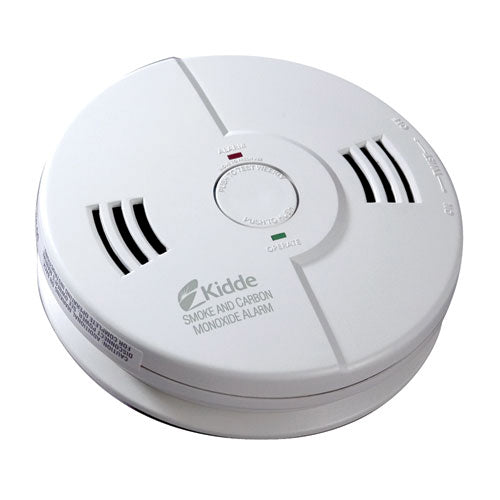
BRK First Alert Interconnected Combination Smoke and Carbon Monoxide Detector with Voice Alerts
Specifications | Manual | Related Blog Posts
Looking for an interconnected smoke and carbon monoxide detector that is feature packed yet economical to install? BRK has one that will knock out its rivals. The ‘voice with location’ feature means this is an alarm that provides necessary
hazard warnings to the visually impaired and the blind.
BRK Electronics claim to be the professional standard for residential safety, a lofty claim. Looking at their track record over the last 50 years I’m tempted to agree with them.
Let’s get down to the nitty gritty.
What’s it good at?
Interconnected – connect up to 12 devices that means bells, horns, strobe lights and more smoke and carbon monoxide detectors.
Voice Alert – the audio alarm has 11 per-programmed locations. That’s right – this alarm will tell you where the alert is taking place e.g. garage, kitchen or bedroom. The alarm has been configured so that the hard of hearing, the elderly and small children will have little trouble hearing this alarm when it sounds.
1 button test – nothing complicated here. Test your alarm with only the push of a button. The only button located on the device. They couldn’t have made it simpler.
8 Hour Hush, for low battery chirp – This for me, is the most important feature on BRK’s First Alert Combination Monoxide and Smoke Detector. It might seem small, but after experiencing a low battery chirp start to go off early on a Sunday night before work, on my previous alarm that didn’t have a hush feature. You can appreciate how much this means to me.
End of Life Alert – Most states require residences to update their smoke and carbon monoxide alarm systems every decade. This unit takes care of that remembering when, for you.
Complimentary Dust Cover Included – BRK makes products for professionals. They understand that new construction sites often have dust and debris flying around which can hinder the operation of a smoke detector. The included dust cover will prolong the life of your unit while you are renovating or completing your construction.
Easy battery backup activation and replacement – a pull tab let’s you activate the battery backup – on your time. That means you can install these on a new construction projects upon completion, and the battery shelf life only starts waning once activated.
Easy replacement – Twist off old unit and twist on the new unit onto the original base.
Locking pin – prevents the unauthorized removal of the battery making this unit perfect for dorm rooms and rental apartments.
What’s not to like? This is a product that connects to all bells and whistles for home safety.
Written by guest blogger Leanne Naidoo
Arlington Roof Topper Supports: Rooftop Conduit Mounts Without the Tricky Installation Factor
Blame it on my childhood Mary Poppins movie binges, but the first time I laid eyes on the product we’re about to talk about, all I could think of were Cockney chimney sweeps shouting “step in time” while dancing and jumping over chimneys, stovepipes and other rooftop obstacles. Not that Arlington Industries’ Roof Topper™ Rooftop Conduit Supports qualify as rooftop obstacles… quite the opposite, in fact.
To be honest, I generally don’t really give what goes on on rooftops a lot of thought, unless a storm with driving winds happens to be forcing rain between my shingles and causing a leak, or, of course, I happen to be curled up in front of the TV watching Julie Andrews and Dick Van Dyke “popping in and out of chalk pavement pictures” and conducting tea parties on the ceiling for the 5,347th time in my life (just an estimate). But the truth is that roofs need to be given quite a bit of though, especially if you need to route pipes or conduit across them and have any respect at all for the National Electrical Code and safety in general.
Roof Topper Rooftop Conduit Supports allow you to elevate conduit and pipes about roof surfaces per NEC requirements without having to drill or install any special hardware. They’re designed with UV-resistant plastic bases that simply sit on your roof deck and allow you to clamp on conduit. That’s it. No heavy rubber blocks that crack and crumble after long-term weather exposure, no power tools or holes in your roof.
Roof Topper supports are intended for use with conduit 4 inches or more in diameter, and are rated to withstand weights of up to 2,000 lbs, so they can tackle just about any job you throw at them. They’re also available in several different configurations, from base-only to models with your choice of struts, end clamps and threaded rods, so all you need to do is select the style you need and install that conduit – so easy! It’s almost enough to make you want to compete in a derby on the back of a carousel horse.
Juicebar Power Tube Mini-Chargers: The Tiny Portable Pick-Me-Up for Gadgets Low on Energy
Filed under: Gadgets, Power and Data Distribution
Ever know you’re going to have a really long day ahead of you, and stash an extra snack or caffeine source in your glove compartment or purse just in case you need to be saved from a serious mood/energy/blood sugar crash before your insane day ends? I do. The last thing that I want is to turn into a surly and/or diva-ish jerk like in the Snickers® commercials, when all that unpleasantness can be avoided with a little pick-me-up. Well, our hard-working gadgets can crash, too, when pushed through long days without enough power to keep them going.
Okay, so I’m not suggesting that a candy bar or energy shot would ever be able to help in the case of tuckered-out electronics, but here’s something very cool that can: the Power Tube Mini-Charger by Juicebar®. Pretty close in size to a bottle of 5-Hour ENERGY®, this miniature charger acts much the same way: it hangs around on standby to provide cell phones and other small electronics with a much-needed power boost when the batteries are starting to run low.
The Power Tube is designed to be charged from a wall outlet (via an adapter), or your computer (via USB connection), and then maintain that charge for up to 30 days, so that it’s ready to go without you constantly having to worry about topping off the charge every few days. When it’s at full capacity, this tiny but impressive emergency charger has enough juice to more than fully charge a standard cell phone battery, which makes a huge difference when you’re faced with situations that can be made or broken by your ability to make a vital call. And emergencies aside, the convenience factor is amazing, even if you’re only faced with a sudden, inconvenient dip in battery power at an inopportune moment… like when you’re calling in a pizza order on your way home from work.
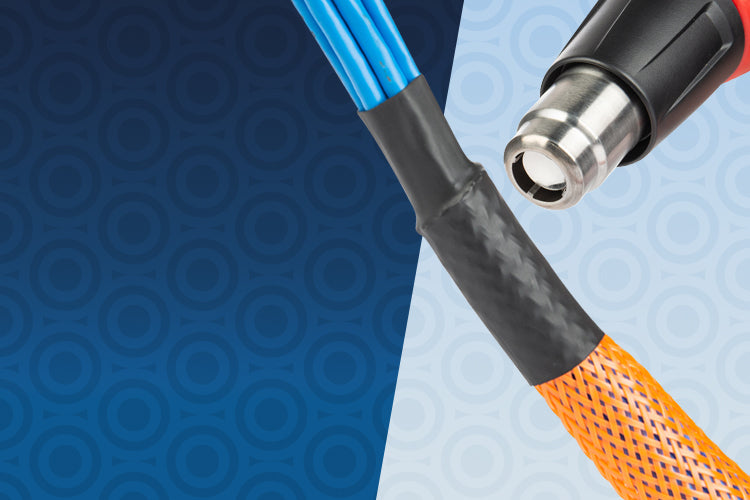
Cold Shrink Tubing: Shrink-Tight Splice Seals Without the Heat
Having been a die-hard Shrinky Dink fan growing up in the ’80s, there’s one particular variety of cable management product that I never seem to get tired of: heat shrink tubing. What’s not to love? It’s easy (and dare I say fun?) to use, comes in lots of bright colors, and, like my old pals the Shrinky Dinks, transforms before your eyes with the simple application of heat. Come to think of it, said heat application doesn’t seem to release the same burning plastic fumes that my little hand-colored charms did while they baked, so maybe heat shrink tubing is even better than the Dinks (but I digress). And the concepts of “heat” and “shrink” just make sense together; if you don’t believe me, try accidentally throwing a “hand wash cold only, line dry” item of clothing into a warm wash cycle and then the dryer. Ouch.
So you can imagine my confusion when I began hearing talk of a little product called “cold shrink tubing.” What? How is that possible? And now I finally know, and can in fact introduce you to some extremely handy cold shrink tubing.
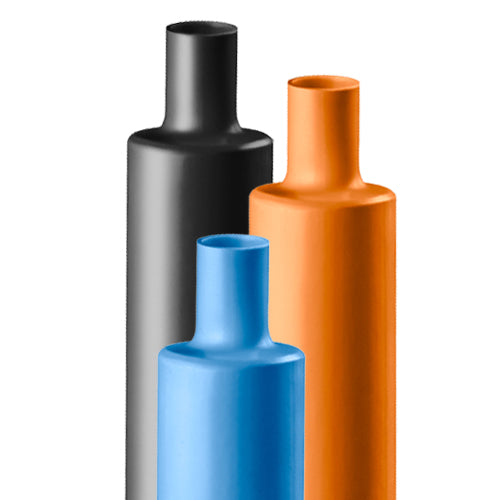
The reason why cold shrink can be shrunken into place cold is because it’s made of stretchy, highly-conforming rubber, unlike traditional heat shrink tubing, which is made of cross-linked plastic that requires relatively high temperatures to go into shape-shifting mode. Heat shrink is basically pre-expanded, irradiated plastic tubing that “remembers” its smaller original diameter when heat is applied. In the case of cold shrink, a length of rubber tubing is stretched over a hollow, larger-diameter plastic inner core, which is slid over a cable or splice until it’s right where you need it, at which point the inner core is removed, and the cold shrink tubing basically snaps back down to its original smaller diameter, creating a snug, weatherproof seal over the wire connection point.
I don’t know about you, but now that I know the complete story behind cold shrink, I’m a little embarrassed that the mere thought of it used to puzzle me. That said, here are a few fast facts and benefits, lest you’re wondering about actual practical applications. First off, it’s only suitable for low voltage applications (like A/V, voice & data, and coax), is UV-resistant (so it’s great outdoors), and obviously, eliminates the risk of burns and overall charring (to components and people alike) due to misuse, or overuse, of heat guns and torches. And since there are no heat tools in the picture, it’s great for using in the field, and tends to free up quite a bit of real estate in your tool kit, which is never a bad thing.
Arlington Gangable Electrical Boxes: Snap and Go for Custom Installs Up to 10 Gang Across
It isn’t everyday that you need a 10-gang electrical box, but if you ever did, wouldn’t it be nice to know that you could snap one together in seconds, without any tools? I think it would be, especially after discovering the totally pieced-together hack job that was lurking beneath the 3 gang wallplate in the laundry room of my 90-something year old house. That’s why I wish that the home electrical noobs who threw together my 1-outlet, 2-switch combo had heard of Arlington Industries’ Gangable Plastic Electrical Boxes before they tried to be enterprising cheapskates.
Arlington’s gangable outlet boxes are an extremely affordable way for electrical contractors and around-the-house handy types to create multi-gang groupings of receptacles, switches, or low-voltage devices without the need to order specific-sized outlet boxes every time. What starts out as a double-gang box can be separated vertically down the middle, allowing you to snap in up to 8 side-free box extenders to create a gang box up to 10 devices across. When it’s wide enough, you have the option of sliding voltage separators between areas that will be housing power and low voltage, to help prevent interference between the two different types of wiring.
The expandable gang boxes are made of plastic, so they’re more flexible (in a good way) than steel boxes, which makes the parts easier to snap together manually and then install. The different components also take up far less storage space than traditional electrical boxes, so if you’re a busy contractor who prefers not to order for each individual job, you can keep a considerable amount of stock on hand without sacrificing your budget or shelf space, and have the freedom to snap together a custom solution at a moment’s notice whenever you need to.
Arlington Gangable Plastic Electrical Boxes can be used in new construction or retrofit projects, and are available in screw-on, nail-on or mounting wing screw styles to work with either wood or metal studs.
Crossover Extreme Duty Cable Protector: Not Your Average Cord Cover
Yesterday, when I was blogging about the Fox™ cord cover, seeing its picture reminded me of another cable protector that has a similar general appearance, but is meant for almost unimaginably tough environments. This is one cord cover that isn’t on my mind often, but when it is, I almost can’t believe how massive it is and what it’s built to handle. It’s for mining and other extreme industrial applications, but you don’t have to be a miner or an engineer to be impressed: meet the Crossover™ Extreme Duty Cord Protector by Peterson Systems.
When I make this next statement, I’m in no way putting down standard heavy duty cable protectors (they’re designed to do a job of a specific size, and they’re great at what they do). But here’s the thing: hearing a weight impact capacity of 10 tons (around 20,000 lbs) just isn’t that impressive anymore when you see that the Peterson Crossover can handle regular vehicular impact loads of up to 350 tons. 350 tons. I don’t know about you, but that blows my mind. I’d love to get an up-close look at the vehicles and machinery these are designed to stand up to.
To accomplish such a monumental feat, you’ve probably guessed that they’re manufactured a just a little differently than your standard cast polyurethane cord cover. While the Crossover™ does incorporate two different grades of Peterson’s proprietary Hiperthane® high-performance polyurethane (one for abrasion resistance, the other for impact resistance), it also works graphite and encapsulated expanded steel into the design for good measure. Overall, the Crossover is nonconductive, non-sparking and self-extinguishing, so it’s safe around all types of machinery in a wide range of abusive conditions.
A few extra features include molded-in receptacles for stands or flags, a custom-molded cable cap that allows you to completely enclose cables or hoses that are dropped into the protective channel, and half-inch proof coil chains that make it easier to drag the Crossover out of mud or sand when it needs to be moved.
The Fox: Tough Single-Channel Cable Protection Without the Flip-Top Lids
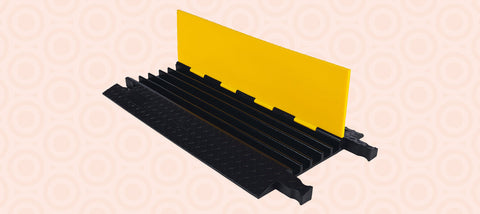
It’s not sly or sexy, so I’m not sure why they call it the Fox™, but you have to admit – this cord cover has a simple, straightforward design that just has a certain appeal. What makes the Fox different from other medium to heavy duty cable protectors? As I was reminded as I traipsed over an endless sea of cord covers at a local Fall festival a few days ago, the first obvious difference is that they don’t have the standard hinged, flip-open tops of most other rugged cable protectors on the market. And secondly, they don’t have the “easy-to-kick-out-of-place-if-it’s-not-actively-anchored-down” dropover design that’s characteristic of many medium capacity cord covers. It like a perfect best-of-both-worlds hybrid of the two. Let me tell you what I mean.
The Fox cable protector has a heavy duty polyurethane body that encloses cables all around and sits firmly on the ground, just like a high-capacity cord cover. But on the other hand, its interior is made up of a single, unsegmented channel, and it’s incredible simple to load, just like most medium-capacity cord covers. Mix those seemingly opposing attributes together, and you get a cable cover that can withstand just over 10 tons (per axle) of vehicle run-over weight and some pretty heavy pedestrian traffic, but is as easy to use as running your hoses and cables through the narrow, flexible open channel along the top.
Flexible, open channel? Of course – how else did you think you were going to get your cables in if there are no hinged lids? The Fox’s cable entry point is a narrow lengthwise channel with flexible sides that let you easily push in or pull out cabtles without the need to open and close covers – it’s really pretty cool, and a perfect solution if you don’t need multiple channels to keep several different cables separate along their path.
Tele-Power Poles Accessories: Faceplates and Cable Management for Completely Custom Power and Data
Filed under: Power and Data Distribution, Raceway, Duct and Conduit
Wiremold Legrand® Tele-Power® Poles have long been a must-have in wide open office spaces where not every desk has the convenience of a wall and the outlets you’d usually find in one. They’re basically designed to let you drop electrical wiring and data cables down from the ceiling anywhere within a room, so that you can have access to power and data connections no matter how far from a wall your workspace is located. Smart, right? They’re a fantastic product.
And now, to make a great thing even better, there are Tele-Power® Pole accessories that make an already custom product even more tailored to fit exactly what you need. This collection of faceplates, grommets, cable managers and trim plates makes it easy to add whatever you need, wherever you need it, while still looking completely polished and professional.
Need an extra pair of power outlets? No problem. Want to add A/V connections alongside your Ethernet ports? Just choose which jacks you need, and pop them into a customizable A/V faceplate. Want to protect bend radius where cables emerge from the ceiling and run down into a Tele-Power Pole? The Data and A/V Add-On Cover is the perfect fit. And those are just a few of your options…
Just like the the Tele-Power Poles they’re accessorizing, all of these parts are designed to be industrial-strength for constant use, and are made of either heavy duty plastic or stainless steel. And just in case you can’t take your utilitarian workhorses without a splash of decor on the side, they’re even paintable to match any nearby walls and fixtures.
Climatronix Stretch Connect: More Fun (and Simpler to Use) Than Your Average Lacing Bar
What do you get when you combine effective and efficient rack cable management with a design that vaguely reminds you of a toy? A really fun way to manage patch cords!
I guess I should start out by saying that rack cable management, while a very necessary and worthwhile thing, has never really excited me. It’s all business – no bells, whistles or sparkles, because why would you need them? Rack cable managers are usually hidden in the dark recesses of server enclosures, so they’re strictly utilitarian. Yawn.
Then I got a look at the Climatronix Stretch Connect™ System, and the fun-loving part of me felt a glimmer of hope. While the Stretch Connect is based on the standard black powder-coated cable management bar design, its top and bottom edges have a very interesting cut-out pattern that not only adds a little visual flair, but is also the key to Stretch Connect’s method of functionality.
Method of functionality? That would be how the Stretch Connect actually controls cables, which, like any other cable bar, is to have patch cords routed and fastened along it. But unlike other cable bars, which tend to make heavy use of cable ties and hook-and-loop wraps that fully loop either around or through both the bars and the cables lashed to them, Stretch Connect employs reusable stretchy connectors, which simply, well, stretch across the front of the bar to hold patch cords in place.
These reusable stretchy connectors have wide grips at the ends, which not only give you a good handhold, but also fit snugly into the cutout edging I mentioned earlier. To fasten patch cords against the Stretch Connect, you just hold the cords in place, slide one end grip behind the cutouts, stretch the strap across the cables, and slip the other connector end behind the opposite cutouts. Fast, simple, and a lot more fun to look at (and use) than most other lacing bars out there.
Grommets: Perfect Cable Management for Any Decor or Environment
I don’t know how familiar you are with grommets, so I thought I’d take some time today to highlight what is actually a very cool and useful (although oddly-named) category of products.
At some point or another, you’ve probably (at the very least) encountered grommets at work, whether they were built into a desktop or conference table, or installed in a countertop near a POS system. Most often, you’ll see them as black plastic rings that are fitted into the cutouts that allow cables to run through work surfaces – the whole idea being that the grommets will buffer the cutouts’ sharp edges so that cables aren’t accidentally scratched up or cut.
But lest you get the wrong idea, let me be quick to add that grommets aren’t limited to the standard-issue black plastic designs, or even to workplaces. You can find them in schools, theaters, entertainment complexes (think all those arcade games), and more than ever, in homes. And speaking of homes, the grommets just keep getting better to keep up with all of those HGTV-worthy upgrades we’re always after, like granite countertops, home theater setups, and modern furniture. There are grommets available in many different designer metal finishes, wood, and even a rainbow of plastics, so no matter what type of surface you need to run cables through, you can rest assured that even utilitarian grommets won’t drag down your decor.
In addition to different styles, materials and finishes, some grommets also multitask – that is to say, they do even more than just organize and protect cables. Some have built-in USB hubs, some have power outlets and data ports – I’ve even seen grommets that double as desk organizers and have compartments to hold pens and other small items. You never know what you might find.